Remember when I wrote last month on inspiration, and how it was okay to run with it as long as you go back to your current story once you're done? Well, there can be a flaw in this plan: what happens if the inspiration becomes the current story?
I have become so fascinated by Project V that it is dominating my attention right now. Even though I still don't have a clear picture of the world, I came up with a good beginning (after several false starts) and am now on Chapter 3, making it up as I go along (which is really what I do best). It's just so interesting, I can't stop!
That said, Project ID has been put on the back burner. I have been under the weather for the past few weeks and, mostly unable to write, lost my momentum. Although I know what to do for the next scene, after that I am completely lost as to where the story is going. This is why I don't normally write mysteries - too much to keep track of! I will have to go back and re-read what I have so far (again) and re-structure my plot points before I can go any further.
As for Project BW, being under the weather has made research difficult, and any I can do has gone towards Project V. So not much is happening.
I hope to get back to Project ID and ultimately finish before really diving into Project V, but until then writing is writing, so I'm not kicking myself too much.
Sunday, June 19, 2011


Saturday, June 18, 2011
Review: The Automat (Hardart & Diehl)
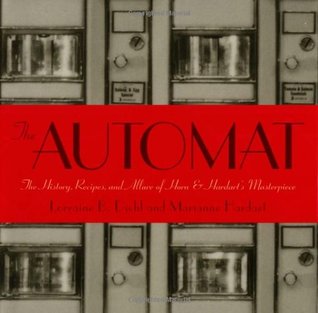
Title: The Automat: The History, Recipes, and Allure of Horn & Hardart's Masterpiece
Author: Marianne Hardart & Lorraine B. Diehl
Publisher: Clarkson Potter
Release Date: November 19, 2012
Genre: Non-Fiction
Format Read: Hardcover (InterLibraryLoan)
Find It On: Goodreads
* * *
Have you ever heard of the Automat? With its nickel throwers and coin-operated food windows and delicious recipes that were tasted by the brass every morning for quality. No? Well, it's about time you did.
The Automat was a really cool chain of restaurants in Philly and New York that prettied up "fast food" in their own special way. Even as it catered to those who could barely rub two nickels together (and if they had two nickels to rub they could go to the Automat for a hot, filling meal), it was also "the place to be" for many famous faces and business icons, and hosted a scene or two in at least a dozen movies.
After reading The Automat: The History, Recipes, and Allure of Horn and Hardart's Masterpiece by Lorraine B. Diehl & Marianne Hardart (yes, of those Hardarts), I went from being simply intrigued by this part-vending-machine-part-cafeteria-part-marvel-of-a-restaurant-chain to being quite fascinated - some would even say a bit smitten. (I have gone so far as to make it a regular setting in Project ID - it deserves it!) But this book doesn't simply tell the story of the Automat - it offers a slice of history from a unique point of view, and gives yummy, top-quality Automat recipes. Don't just read the history, taste it too!
The Automat was a magical place that, unfortunately, now exists only in the memories of workers and patrons. It's a sad ending, but worth the read.
So Google the Automat to whet your appetite, and then check out The Automat by Diehl & Hardart from your local library. It's a thin book and tons of fun to read.
Scribble Rating:
4 of 5 Scribbles

Friday, June 3, 2011
Project Updates
It's been a while since I last posted! I've been busy reading a ton and writing a little. (I know - it really should be the other way around. Bad Jane!)
I have started two new projects: Project BW and Project V.
Project BW I have "mentioned" before - I consider it my Ultimate Story, and it is a doozy! I have a ton of research ahead of me, so I've decided to take my time and create it properly. It'll happen one day, but it will be several years from now. All I can say so far is that it's set on an alternate timeline and deals with books.
Project V I consider my "Ultimate YA Series." My Harry Potter, if you will - or probably more like my Hunger Games, but only because it's a trilogy and geared towards older teens (that's about all they have in common). I have been researching and mapping common denominators in popular young adult series for about a year now, and it has finally paid off. It's still in the very early planning stages, but the concept is coming along nicely. It's sort of about a secret society and ghost-like beings, but really isn't - I not quite sure how to describe it yet.
Project ID is coming along slow but relatively sure. The plots are a bit of a rat's nest right now, but I'm discovering ways to keep them straight. The writing part is going pretty smooth, thankfully - when I actually sit down and do it (again, bad Jane!). The actual "putting your butt in the chair and writing" part has always been my hardest obstacle.
So my one project has turned into three. But so is the life of a writer.
I have started two new projects: Project BW and Project V.
Project BW I have "mentioned" before - I consider it my Ultimate Story, and it is a doozy! I have a ton of research ahead of me, so I've decided to take my time and create it properly. It'll happen one day, but it will be several years from now. All I can say so far is that it's set on an alternate timeline and deals with books.
Project V I consider my "Ultimate YA Series." My Harry Potter, if you will - or probably more like my Hunger Games, but only because it's a trilogy and geared towards older teens (that's about all they have in common). I have been researching and mapping common denominators in popular young adult series for about a year now, and it has finally paid off. It's still in the very early planning stages, but the concept is coming along nicely. It's sort of about a secret society and ghost-like beings, but really isn't - I not quite sure how to describe it yet.
Project ID is coming along slow but relatively sure. The plots are a bit of a rat's nest right now, but I'm discovering ways to keep them straight. The writing part is going pretty smooth, thankfully - when I actually sit down and do it (again, bad Jane!). The actual "putting your butt in the chair and writing" part has always been my hardest obstacle.
So my one project has turned into three. But so is the life of a writer.
Wednesday, May 18, 2011
The Beauty of Brainstorming
I am a ceaseless advocate of the importance of brainstorming. Without it, my stories would be flat and confusing - and extremely short.
Brainstorming gives you the opportunity to take a question or concept of your story and let your mind run with it, asking what it will and throwing out ideas - good, bad, and off-the-wall - to see where they lead. Eventually one of those ideas will make you pause and think: yeah, that might work. So you run with the idea some more. When you are done asking questions and testing ideas (or until you can't think straight anymore), you [should] discover that your questions are answered, and your story has expanded exponentially with even more complex characters and layered plot. (Make sure you give yourself a few uninterrupted hours to hold the session, though - your brain needs a continuous thought stream or you'll lose track of those ideas, and possibly even the questions.)
A few days ago when I sat down to write, I was pondering an article I had read that morning which pointed out a blaring problem I had been wrestling with. "They" say (and I do listen to "Them," occasionally) that a good story has both an external struggle and an internal struggle - meaning both an outward situation and a personal conflict that your character must deal with. And a time limit. For ID, I had my outward situation set, but I hadn't come up with a personal problem or a time limit for EP to deal with. And as I found myself scrounging for more plot at only 15,000 words, I could see there had to be more to the book - or it was doomed. It was time for a brainstorming session.
What spawned out of those hours of brainstorming gave me not only a personal conflict and a time limit, but the back story for the antagonist's motive, a few new key characters (who only help by being murdered, but still), future tension and danger, and...well, the list is quite extensive.
When I finally stopped (my head dizzy with intersecting plot points and characters), I had more than enough material to run with (80,000+ words, here I come!), and was really excited to begin writing again.
Brainstorming can be used for plot, character, or both - or anything, really. By writing down your chaos of thoughts, patterns emerge. And once it's down you can organize it, discovering what your mind was trying to say but couldn't through the tangled mess in your head. And once it's untangled, you'll be surprised by what you can come up with, if you only let your imagination run free.
Brainstorming gives you the opportunity to take a question or concept of your story and let your mind run with it, asking what it will and throwing out ideas - good, bad, and off-the-wall - to see where they lead. Eventually one of those ideas will make you pause and think: yeah, that might work. So you run with the idea some more. When you are done asking questions and testing ideas (or until you can't think straight anymore), you [should] discover that your questions are answered, and your story has expanded exponentially with even more complex characters and layered plot. (Make sure you give yourself a few uninterrupted hours to hold the session, though - your brain needs a continuous thought stream or you'll lose track of those ideas, and possibly even the questions.)
A few days ago when I sat down to write, I was pondering an article I had read that morning which pointed out a blaring problem I had been wrestling with. "They" say (and I do listen to "Them," occasionally) that a good story has both an external struggle and an internal struggle - meaning both an outward situation and a personal conflict that your character must deal with. And a time limit. For ID, I had my outward situation set, but I hadn't come up with a personal problem or a time limit for EP to deal with. And as I found myself scrounging for more plot at only 15,000 words, I could see there had to be more to the book - or it was doomed. It was time for a brainstorming session.
What spawned out of those hours of brainstorming gave me not only a personal conflict and a time limit, but the back story for the antagonist's motive, a few new key characters (who only help by being murdered, but still), future tension and danger, and...well, the list is quite extensive.
When I finally stopped (my head dizzy with intersecting plot points and characters), I had more than enough material to run with (80,000+ words, here I come!), and was really excited to begin writing again.
Brainstorming can be used for plot, character, or both - or anything, really. By writing down your chaos of thoughts, patterns emerge. And once it's down you can organize it, discovering what your mind was trying to say but couldn't through the tangled mess in your head. And once it's untangled, you'll be surprised by what you can come up with, if you only let your imagination run free.
Monday, May 16, 2011
When Inspiration Strikes
Never fear inspiration. "Of course not!" you say. "What writer would fear such a blessing?" Well, "they" can sometimes tell you that, while you are working diligently on one story, you should not work on any others. And if inspiration strikes you on another story? Well, just jot down a few notes and ignore it.
With no respect to "them," this is insane. Inspiration, no matter which of your stories it concerns, should never be ignored! Take a break from your current story and let your inspiration take you where it will.
But there's a catch: once the inspiration ends, you must go back to your current story.
This is where I always had trouble. I would get so caught up in the new story that I would put the old story completely out of my mind. And by the time inspiration died on the new story, the old story was a boredom best left until inspiration struck for it. And normally, it never did.
So if inspiration strikes you, run with it. But no matter if it's for a day or a week, make sure you always keep your current story at the front of your imagination, directly behind that shining inspiration. That way, when the inspiration finally vanishes (as it always will), your current story can step right back into front position (where it belongs). Always strive to finish what you start!
With no respect to "them," this is insane. Inspiration, no matter which of your stories it concerns, should never be ignored! Take a break from your current story and let your inspiration take you where it will.
But there's a catch: once the inspiration ends, you must go back to your current story.
This is where I always had trouble. I would get so caught up in the new story that I would put the old story completely out of my mind. And by the time inspiration died on the new story, the old story was a boredom best left until inspiration struck for it. And normally, it never did.
So if inspiration strikes you, run with it. But no matter if it's for a day or a week, make sure you always keep your current story at the front of your imagination, directly behind that shining inspiration. That way, when the inspiration finally vanishes (as it always will), your current story can step right back into front position (where it belongs). Always strive to finish what you start!
Monday, May 9, 2011
Rule #1: In late, out early
"In late, out early." This is one of the most well-used and well-known writing sayings today simply because it should always be followed. (This is especially true of YA fiction and younger genres, though apparently not so much for adult fiction if most published works are any indication - but don't get me started on that.)
This saying literally means you should begin each chapter (or scene) either at the last possible moment before or right after something interesting happens - and then end the chapter/scene right after it's over. No backstory infodump, no unnecessary description, no filler. Just the best bits of the story - not much more, not much less.
Backstory is mainly for the author's information only. Plot and write whatever backstory you need to, but unless it's absolutely necessary to the story, you shouldn't use it in the book. If you do need to explain something about a character's past, or perhaps a bit of world history, mix it into another necessary scene - don't just infodump it wherever it "feels right." The same goes for description. Weave it into the narrative using the character's senses. Don't "set the scene" (start a scene with a block of description) unless the scene truly needs setting (and in most cases, it doesn't).
The only time filler is appropriate is for pace padding (so the story flows properly), and even then filler should only be necessary information to further the story. I just used a bit of filler in ID - I felt the need to expound a few paragraphs on EP and AD's history together while they were driving to NYC. When I got done, though, I felt a bit dirty for throwing in the part-flashback/part-infodump scrap of filler, and will most likely trim it down to bare facts in editing.
Every scene, paragraph, sentence, even word, should inform the reader of necessary information and move the story along. If it doesn't do this, it doesn't belong. I don't care if it's your favorite scene in which Martin goes to the Laundromat to wash his socks and runs into a batty old woman. If this old woman (or his socks) doesn't end up predicting a dastardly event in Martin's future, and instead simply annoy him, then the reader doesn't need to know about it. I don't care how many hours you put into crafting the old woman (or his socks). (But if it's already written, don't toss it! Literary Deleted Scenes now have a place: on your website.)
Now, I'm not saying that you should fret every time you begin a chapter/scene, worrying if you're starting at the right point. The First Draft is for getting down whatever flows out of you. If Martin suddenly goes to the Laundromat, let him. He may end up just washing his socks, or the batty old woman may predict his death. It isn't until later drafts that you need to worry if something furthers the story or not. Write whatever comes to you - and then prune it like a bonsai later.
Saturday, May 7, 2011
Some Imagination Words
These lyrics from "Gone In the Morning" by Newton Faulkner describe how I feel when I sit down to write:
Off to a land where no one’s been before
I’m going to take my shoes off at the door
I’m going to go where dreams like rivers flow
When the alarm goes off I just won’t know
Won’t you come with me
And what the vastness of writing feels like:
I’m going to master all kinds of kung-fu
I’m going to live inside a tiny zoo
I’m going to grow myself a giant afro
When the alarm goes off I just won’t know
Won’t you come with me
Fortunately, it's never "gone in the morning." (Incredible.)
Subscribe to:
Posts (Atom)